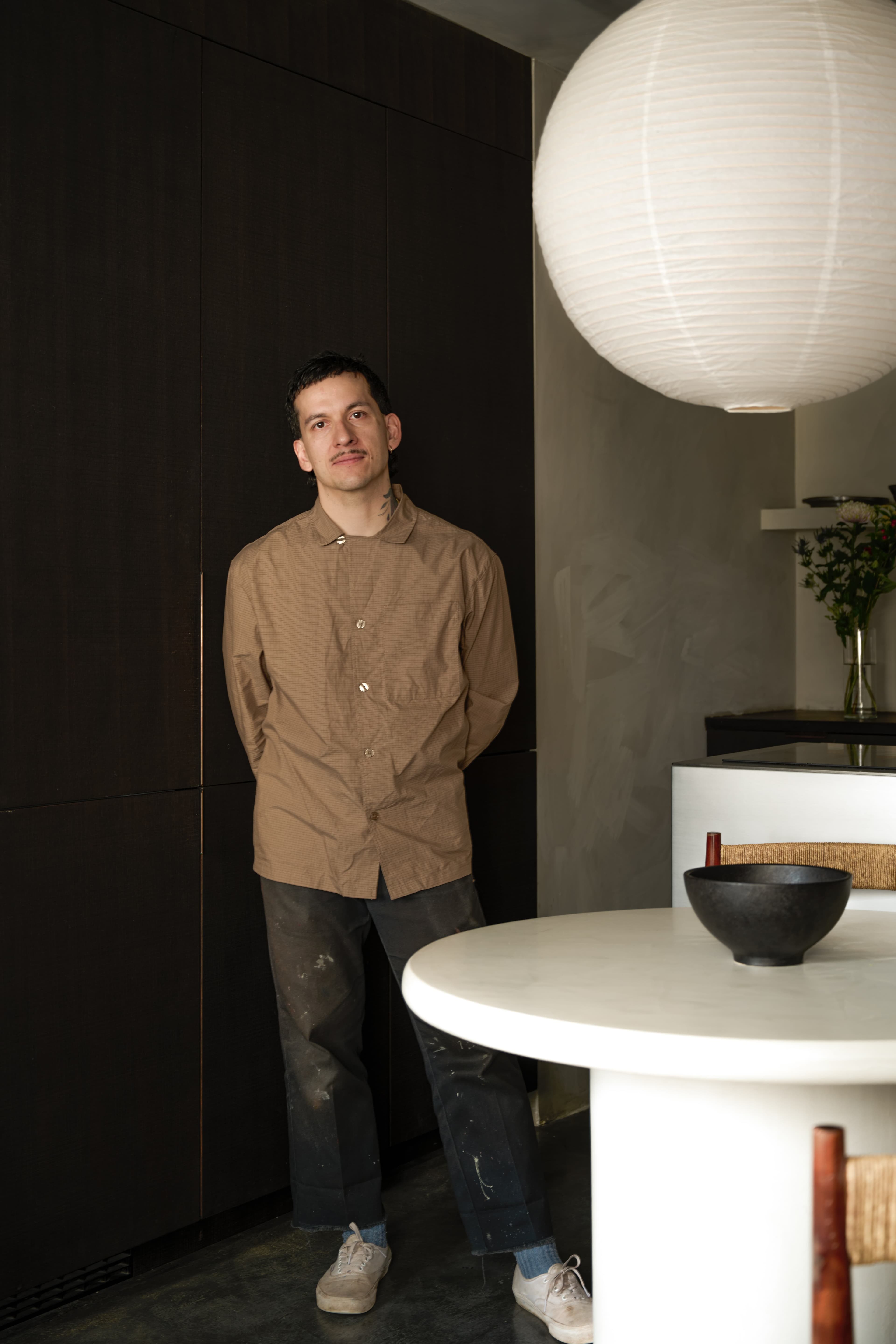
At Home w/ Christian Butler of Studio Limited
Christian Butler is a Denver, Colorado–based architect who thinks carefully about how homes respond to their environment and the people living in them. As the founder of Studio Limited, Butler blends minimalist restraint with a human-centered sensibility, prioritizing privacy, proportion, and creating a sense of calm – particularly within dense urban contexts.
This interview was conducted by Jorgen Jensen, Co‑Founder of Fantastic Frank Colorado, who first met Butler nearly a decade ago while representing a residential project Butler had designed in Denver’s Whittier neighborhood. Since that initial collaboration, the two have become great friends. Today, Jensen lives next door to Butler in Curtis Park – in a home Butler designed and built – offering a uniquely personal lens on how architectural vision translates into everyday life. Sitting down for this conversation, not just as colleagues but as friends and neighbors, offered a rare and personal perspective into the philosophy behind his work. In the interview that follows, Christian reflects on designing with purpose, navigating regulatory constraints, and creating architecture that fosters inner stillness and a deeper connection to place.

Where did you grow up, and where did you study architecture?
I was born in Virginia but moved around a lot as a military brat, bouncing around Asia for much of my childhood. I continued a fairly nomadic life until calling Denver home starting in 2009. I came to architecture later in my career after getting an undergrad degree in international business and mostly working in construction, including building affordable housing with Habitat For Humanity. I went on to attend Taliesin, the Frank Lloyd Wright School of Architecture for my master’s degree.
You studied at Taliesin West rather than a large, traditional university program. What distinguishes that experience from more conventional architectural education?
Taliesin was a very small and intimate program where the Apprentices (as the students were called) lived, studied, and worked on Frank Lloyd Wright’s two historic estates, Taliesin and Taliesin West. Unlike a conventional program, it offered an extraordinary opportunity to learn by being immersed in the history and architecture of FLLW, as well as experiment with hands-on learning and building. It was the kind of place where you had a lot of room for self-authorship, and the more you put in the more you got out of it.

Looking back, what was the single most formative lesson you took away from your time at Taliesin West?
One of the biggest lessons was that architecture is about more than just buildings. The buildings create a setting for life and community and the vision can be much bigger when architecture is seen as a context to live out a vision.
Studio Limited sits at the intersection of developer, architect, and builder. How does wearing all three hats shape the way you think about design from the outset of a project?
I value being involved in all three aspects of a building. For me, architecture isn’t just about the bones of a structure, it’s about a vision for life, and by being involved in all aspects it provides for a much more aligned execution. Additionally, by understanding the financial reality, the challenges of construction, and the vision for design, I can align all of them into a more graceful solution that respects each, but works in synergy for a better project.

Many of your projects emphasize restraint – fewer materials, fewer gestures, more intention. How do you know when a design has arrived at the right level of simplicity?
While I do lean heavily towards minimalism, the goal is not in and of itself to reduce a project to its bare necessities. I spend a lot of time looking for refined solutions, which very much includes searching for an option to achieve the goal with fewer materials and less fuss. That being said, I prioritize the human experience over intellectual reductionism. When I can’t think of a way to increase simplicity while maintaining the vision I call it complete. The beauty of architecture is that it is a practice and I’m always learning and improving my craft. There’s unlimited room for growth.

Light, privacy, and calm show up repeatedly in your work, even on dense urban sites. What strategies do you return to when designing homes in the middle of the city?
Designing in a tight urban environment is challenging due to the level of predefined constraints and limited options when it comes to siting a building. In an ideal situation I can design several homes next to each other and thus control view lines and exposure to neighboring buildings, but even when that isn’t an option I have a handful of design moves that help to bring in light and views while maintaining privacy. The use of lightwells and courtyards work well even though on a small site it can be difficult to make them fit. For me, trading some interior square footage to gain a private courtyard is well worth it most of the time. I love having floor-to-ceiling windows that look into a private garden while maintaining privacy in a dense urban environment.

You’ve described homes as places for people to heal and thrive. How does that philosophy translate into specific architectural decisions?
For me home is a place of respite and calm, a place where we can regroup and center ourselves. Architecturally this translates to me as a place of simplicity, natural light, privacy, and views into gardenscapes. I keep an acute awareness around proportions, scaling rooms and ceiling heights such that they are comfortable to the human scale. Progressively I am also incorporating natural materials and elements of human craftsmanship in the finishes that also add to a sense of tranquility.
Several of your earliest projects were self-initiated developments. What did those first experiences teach you about architecture that practice alone might not have?
Working on the entire development process taught me a lot about why the built environment looks the way it does. My p
rojects have been more specific and unconventional compared to most, and I personally experienced the difficulty
of working with banks to obtain financing, going through the city permitting process, and teaching construction crews alternative building methods. The reason so many buildings look the way they do is that they efficiently navigate the system that is in place, and is the path of least resistance. Often the architectural vision is lost during this process, especially when the developer’s prerogative to maximize profit and minimize risk is driving most decisions. Working on self-developed projects helped me build understanding, as well as empathy for the challenges of realizing architecturally significant buildings. It also helped me to hone my design practice to try and solve all of these issues in one holistic approach.

You’ve spoken about working within – and sometimes at the edges of – zoning and regulatory constraints. How do limitations become a design tool rather than an obstacle?
Working in the urban environment necessitates significant creativity to navigate the plethora of regulatory constraints. I typically begin my design process by first gathering information on all relevant code requirements so that when I start visioning solutions for the project they are set firmly within the actual real world parameters. I enjoy the process of problem seeking before turning on problem solving. The better I understand the constraints, the better the solution will be.
Occasionally I find myself up against a zoning code that is limiting a good design solution. Instead of just accepting it as impossible, I work hard to find creative solutions that follow the letter of the code, but push for novel outcomes. This often delays the permitting process as getting approval for innovative solutions usually requires running it up the chain of command through an appeals process, but has resulted in better buildings and opportunities for the city to clarify the code intent. I try to pick my battles and make sure it’s worth the time and frustrations that result in working within bureaucracies.

Rather than mimicking historic styles, your work often exists in quiet dialogue with its surroundings. How do you think about context while still allowing a project to have its own identity?
I neither try to mimic historic styles, nor do I avoid integrating the design tools and knowledge of the past. Innovation isn’t a goal itself, nor to reinvent the wheel, but I do try and create solutions that are specific to the time and place of the project. I have my own aesthetic voice, but much of it has been learned through experience of others’ work, as well as academic studies. I do try to have my buildings show respect to their context in terms of scale and material, but I’m also comfortable with them having a unique, and often contrasting presence. Personally I find diversity in the built environment a positive attribute, and appreciate when buildings can enhance the beauty of each other by standing in their own identity.
Living in projects you’ve designed has clearly influenced your thinking. What lessons only emerge when you inhabit your own work?
Living in my own work is one of the greatest educational tools I have. I built my last two houses and I’m starting to work on the next one. I often experiment with new ideas on myself, and after living with the results, can decide whether to iterate them into future projects. I’ve experienced times where I put too much time and effort into a particular detail only to realize once being in the home that it made little difference to my lived experience. I also have found that other details or layout ideas that I thought were good enough really irritate me in the outsized impact they make when I’m in the home daily. Living in my own work accelerates my awareness of what matters and where to prioritize my time and efforts on subsequent projects in an intimate way.

Many of your buildings prioritize inner sanctuaries – courtyards, light wells, moments of pause. Why do those interior experiences matter so much to you?
Inner peace and awareness of the present moment are some of my strongest motivators. Having physical moments of subtlety and refined beauty remind me of the opportunity to slow down and center myself. I love watching how the daylight shifts across my inner courtyard wall throughout the day. It reminds me of the importance of being present, and the beauty of the world that is available if we slow down long enough to observe it.

Over time, certain architectural voices tend to stay with us. In what ways has Luis Barragán shaped how you think about emotion, light, and atmosphere in architecture?
Luis Barragán is one of my significant influences. I love that his work is firmly modernist and minimal, while also poetically integrating art, natural materials, and connection to landscape. His work is all about the depth of the human experience, and elicits an emotional reaction while also maintaining a deep humility. His acceptance speech for the Pritzker Prize in 1980 is one of the most eloquent arguments for the powerful human impact architecture can, and should, have.

When you step back from individual projects, what do you hope people feel when they experience a Studio Limited home – beyond how it looks?
I always hope that people thrive in spaces I’ve designed. I want them to feel a deep connection to themselves, to others, and to the planet. I know that architecture isn’t prescriptive, but I do believe it can have a powerful impact and I don’t take my role lightly when it comes to shaping spaces that are conducive to deep human experience. I hope my homes are containers that remind them of the importance of beauty, offer moments of connection, and support them in times of challenge and grief.
Fantastic Frank Colorado is currently representing a home for sale that was designed and built by Studio Limited. To view the listing visit the following link, High House by Studio Limited.
Visit Studio Limited.
Read More
View All