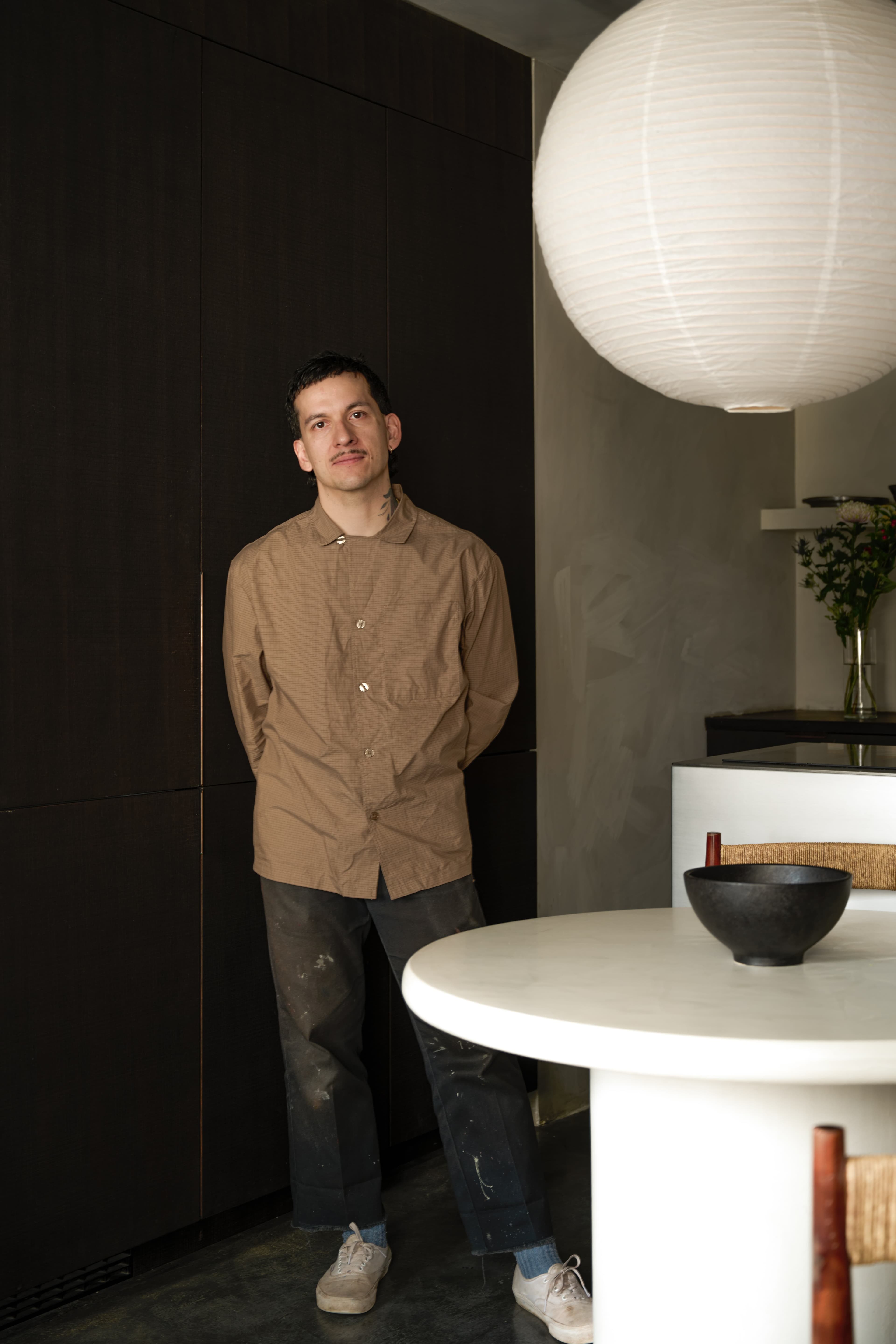
A Frank Chat with Armando Mesías
A sense of in-betweenness runs through the work of Armando Mesías, a sensitivity to material, memory and movement that feels both intimate and spatial. Born in Cali, Colombia and now based in Madrid, Armando works across abstract painting and textile-based surfaces, combining found fabrics with expressive mark-making and unconventional organic materials such as coffee, oil and other studio elements. His compositions carry traces of touch and time, reflecting on how identity shifts across geographies.
Textiles travel easily, yet absorb context. In his hands, a domestic fabric becomes layered and unstable in meaning. Composition, for Armando, is not only visual but structural, built through accumulation, erosion and reconstruction.
The photographs in this Journal were taken in one of his Hilma Homes rental projects in Madrid, a space curated with the same sensitivity that defines his studio practice. Here, art is not simply placed within a home, but integrated into its rhythm.
In this conversation, we move between the solitude of the studio and a wider dialogue with the world, reflecting on how art shapes the way we inhabit and create our homes.

What themes or impulses are currently driving your practice?
My work is driven by a persistent tension between belonging and displacement. I’m interested in how identity fractures and reassembles when you move across geographies, languages and social codes.
Working with domestic materials such as textiles, found fabrics and surfaces that carry the memory of touch has been an important part of my research over the past few years. These materials travel easily, yet they absorb context. A tablecloth in Cali is not the same tablecloth in Madrid. The material shifts meaning depending on where it lands.
I’m drawn to that instability, to the idea that identity is layered, almost architectural.
How personal is your artistic practice to you?
It’s deeply personal, but not autobiographical in a literal way.
I don’t narrate my life directly. Instead, I work with structures that mirror emotional states: fragmentation, repetition, erosion and reconstruction. Migration, for example, is not presented as a story, but as a condition embedded in the materials themselves.
The personal enters through intuition, through what I’m drawn to collect, tear, stitch or preserve.

Do you see your practice as a solitary process, or as part of a larger conversation?
The studio is solitary, but the work is not.
I see my practice as part of a broader dialogue about global homogenization and the illusion of connection. Images, objects and aesthetics circulate constantly, yet social and political borders remain rigid.
My work exists within that contradiction. It absorbs references from different contexts without fully resolving them. I’m interested in that friction, in what happens when elements coexist without fully merging.
What parallels do you see between your artistic practice and the way you curated the Hilma Homes spaces?
For me, curating a space is about constructing emotional rhythm.
In the studio, I work through layering. Surfaces accumulate marks, textiles overlap, fragments coexist without dissolving into one another. The Hilma Homes spaces followed a similar logic. I wasn’t looking for conventional cohesion, but for balance between softness and weight.
A home, like a painting, needs breathing space. It also needs tension.

What role do you believe art plays in shaping the identity of a home?
A strong artwork introduces a different tempo into a room. It shifts the hierarchy of objects and alters how the space is perceived.
Art anchors a home psychologically. It brings narrative and intention into the room, even when abstract. It is often what makes a space feel claimed rather than simply arranged.
For someone who may feel intimidated by buying art, what advice would you give? How should someone begin curating their home with art in a meaningful way?
Start with what holds your attention longer than expected.
Not what matches the couch, but what creates a subtle shift in the room. Living with art is a relationship. You don’t need to understand everything intellectually. You need to feel that it changes your perception of the space.
Collect slowly. Let your home evolve with you.

Where do you feel your work is evolving at the moment? Is there something new you are exploring or moving toward?
I’m returning to the origin of the gesture, to drawing as an intentional act.
For years I’ve worked through layered compositions. Surfaces function almost like objects, built through accumulation and material tension. Now I’m interested in integrating that language with the subject in a subtle way.
If the figure appears, it is cryptic, almost dematerialized, more suggestion than physical presence.
It’s a return to drawing and intention while still carrying the full weight of textile and abstraction.

Quick Reflections
A material you are drawn to right now?
Worn cotton and raw canvas before it becomes anything else.
A place in Madrid that inspires you?
La Latina, walking down Calle Segovia, where the compressed streets open and the neighborhood exhales into something quieter and more organic.
One element that transforms a space into a home?
Small dissonances.
The slight misalignment between intention and use. The objects that respond to daily life rather than pure aesthetics. That subtle irregularity is what makes a house feel lived in rather than staged.

A Layered Sense of Belonging
For Armando, art and space follow a similar logic. Both are shaped through layering, tension and the need for breathing room.
Inside Hilma Homes, that thinking becomes tangible. The rooms are not staged toward perfection, but composed with intention. Materials carry presence. Art shifts the rhythm of the space.
What remains after this conversation is a clear perspective: identity, like a home, is not constructed in a single gesture. It accumulates. It absorbs context. It shifts meaning over time.
Living with art, as Armando suggests, is less about certainty and more about attention. A home evolves slowly through what we choose to keep, collect and return to. In that gradual layering, belonging is not fixed, but continually redefined.

Read More
View All


